
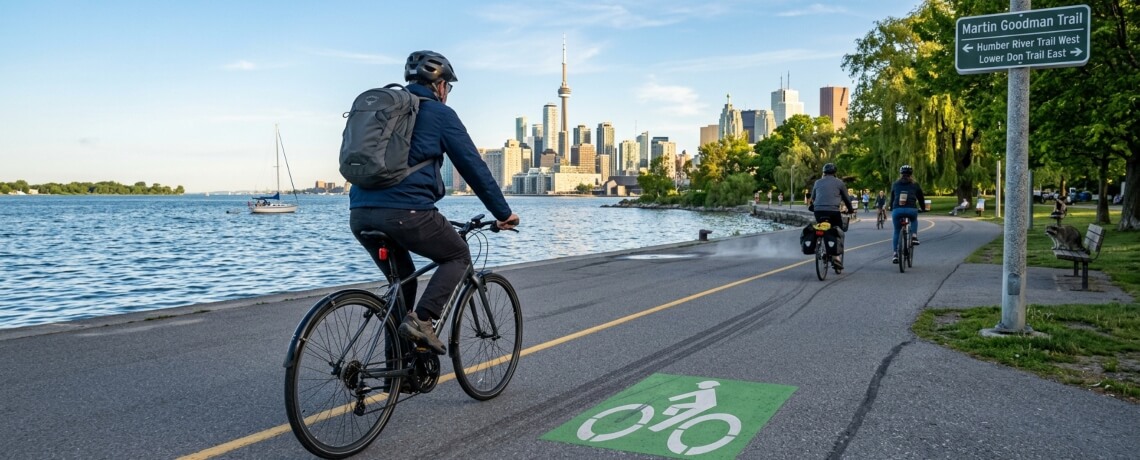
The best bike trails Toronto has are the Martin Goodman Trail along the waterfront, the Humber River Recreational Trail and the Lower Don Trail. All are paved, separated from car traffic, and connect to each other, so you can ride from the suburbs to downtown almost entirely off-road. Here are seven of the best biking trails Toronto has, from waterfront paths to ravine routes.
Toronto Bike Trails Compared
All the Toronto biking trails below are paved or hard-packed and connect to each other, so you can string several into one ride.
Trail | Length | Surface | Best for |
|---|---|---|---|
Martin Goodman Trail | 56 km | Paved | Waterfront rides, commuting |
Humber River Trail | ~20 km | Paved + packed gravel | Ravine scenery, north-south commutes |
Lower Don Trail | ~7 km | Paved | Fast route into downtown |
Tommy Thompson Park | ~5 km one way | Paved | Car-free weekends, skyline views |
High Park Loop | 5 km | Paved | Easy loops, families |
Don Mills Trail | 3 km | Paved | Quiet rail-trail riding |
Finch Hydro Corridor | ~15 km | Paved | East-west rides across North York |
1. Martin Goodman Trail
The spine of Toronto cycling: 56 km along the Lake Ontario shore from the Humber Bay Arch Bridge to the Rouge River, open since 1984 and part of the 3,600 km Great Lakes Waterfront Trail. The central Humber-to-Beaches stretch is flat, fully paved and lined with Bike Share stations a few hundred metres apart. Busy on summer weekends in the Harbourfront section – ride early if you want speed.
2. Humber River Recreational Trail
Roughly 20 km following the Humber, a designated Canadian Heritage River, from the lake north through Etobicoke toward North York. Mix of pavement and hard-packed gravel, passing Etienne Brule Park and the Old Mill. Connects to the Martin Goodman Trail at Humber Bay and to the Finch Hydro Corridor up north, which makes it a legitimate commuting route, not just a scenic one.
3. Lower Don Trail
The fastest off-road way into downtown from the east side. The trail runs along the Don River from the ravine network down to Corktown Common, where it meets the waterfront. Expect cyclists in commuter mode on weekday mornings. North of it, the Don Valley trail system (Beltline, Bayview multi-use trail, Brick Works) adds hills and gravel for riders who want a workout.
4. Tommy Thompson Park (Leslie Street Spit)
A man-made peninsula reaching about 5 km into the lake, with the best skyline view in the city at the end. Open to the public on weekends and holidays, and car-free – which makes it the most relaxed ride on this list. Access from the Martin Goodman Trail at Leslie Street.
5. High Park Loop
A 5 km circuit inside Toronto’s largest park. Short climbs, lots of shade, and quiet roads shared with slow park traffic. Good first ride for kids and a standard hill-repeat spot for road cyclists before 9 a.m.
6. Don Mills Trail
A 3 km rail-trail on the old Leaside Spur line, running parallel to Leslie Street between York Mills Road and Eglinton. Flat, straight and uncrowded – locals use it as a connector toward the East Don trails.
7. Finch Hydro Corridor Trail
A paved path under the hydro towers across North York, roughly 15 km east-west. No lake views, but it links the Humber Trail, G. Ross Lord Park and the East Don network, and it’s one of the few continuous east-west routes in the north of the city.
Cycling to Work in Toronto
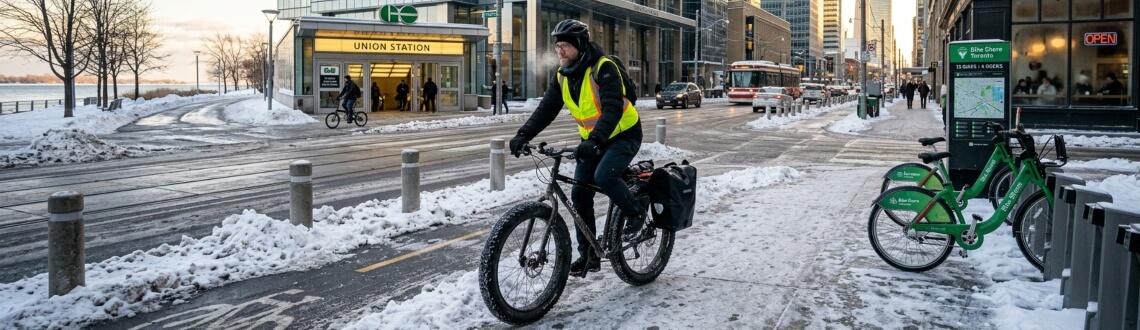
Bike commuting here is more practical than the city’s reputation suggests. The trail network handles the long distances; the last kilometres run on street bike lanes, which are densest downtown. Three things that make it work: GO trains accept bikes outside weekday peak hours, so you can combine a train leg with a ride; Bike Share covers the downtown core densely enough that you don’t need to own a bike at all; and winter riding is realistic on major trails – the Martin Goodman Trail is maintained year-round, though lake wind demands proper layers.
Bike Share Toronto in Numbers
Metric | Figure (2025) |
|---|---|
Trips taken | 7.8 million, up 10% from 2024 |
Stations | 1,000+, across all 25 wards |
Bikes in fleet | 10,251, including 2,319 e-bikes |
First-time riders | About 231,000 |
2026 expansion | 750 new bikes, 200 e-bikes, 350 charging docks |
E-bikes are the growth engine: they deliver more than twice as many trips per day as regular bikes, and the system set monthly records in July and August 2025 with over a million rides each.
Quick Facts
- The Martin Goodman Trail is named after a Toronto Star editor-in-chief and opened in 1984 – decades before bike lanes became a Toronto political battleground.
- Bike Share ridership grew from about 665,000 trips in 2015 to 7.8 million in 2025 – a twelvefold increase in a decade.
- The Humber is one of Canada’s official Heritage Rivers; you can ride beside it for its entire urban length.
- Tommy Thompson Park exists by accident: it was built from construction rubble as a breakwater project, then taken over by birds, coyotes and cyclists.
FAQ
- Which Toronto bike trail is best for beginners? The central Martin Goodman Trail or the High Park Loop – both flat, paved and easy to bail out of at any point.
- Can I take my bike on the TTC or GO? Yes, outside weekday rush hours on both systems. GO publishes specific peak-period restrictions for trains arriving at Union.
- Are the trails open in winter? Major routes like the Martin Goodman Trail are cleared year-round; ravine trails like the Lower Don can stay icy after storms.