
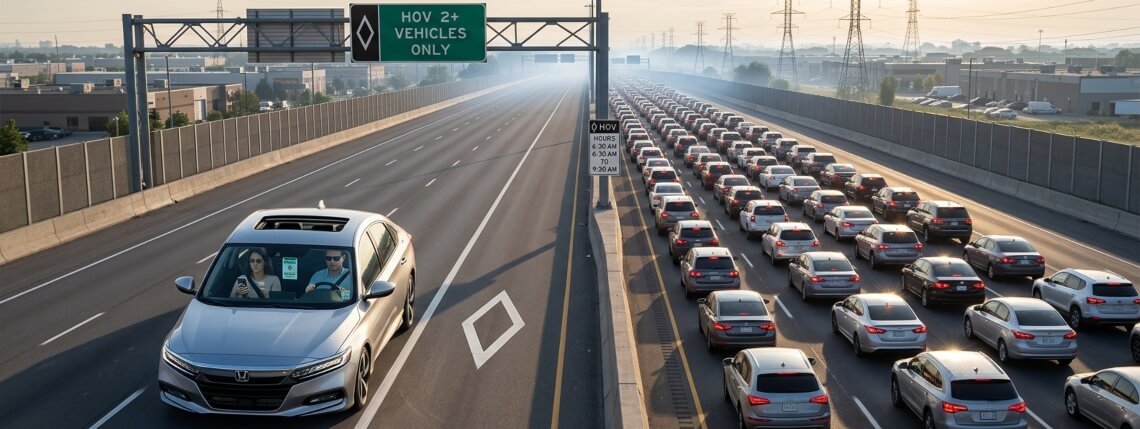
Carpooling means two or more people sharing one car for trips they would otherwise drive alone. In Ontario, a car pool with at least two occupants can use HOV lanes on 400-series highways, and splitting fuel and parking typically cuts commuting costs by 40-50%. Whether you carpool to work in Toronto or share a longer intercity ride, the setup is the same. Here is how to set one up.
What Is Carpooling?
A carpool is a recurring arrangement where drivers and passengers travel the same route together and share the cost. The classic example is two or three coworkers taking turns driving to the office. There is no company in the middle: you agree on pickup points, schedule and cost-sharing directly. Statistics Canada data shows why the idea keeps coming back: 89.5% of Canadians who drive to work do it alone, and Toronto has the longest average commute in the country at 34.9 minutes one way (May 2025). Every carpool removes at least one of those solo cars from the road.
Carpool vs Rideshare Toronto: Not the Same Thing
People use the two words interchangeably, but in practice they are different services. A rideshare Toronto service usually means Uber or Lyft: you pay a commercial fare for a one-off trip. A carpool is cost-sharing between private individuals, often the same group every weekday. The table below shows where each option fits.
Carpool | Rideshare (Uber, Lyft) | |
|---|---|---|
Who drives | A commuter going the same way | A commercial driver |
Price | Shared costs (gas, parking, 407 tolls) | Metered fare plus surge pricing |
Schedule | Fixed, agreed in advance | On demand, any time |
Best for | Daily commutes, intercity trips | One-off trips, nights out, airport runs |
HOV lanes | Yes, with 2+ occupants | Yes, with a passenger on board |
HOV Lane Rules in Ontario
HOV (high-occupancy vehicle) lanes are the single biggest practical perk of carpooling here. The rules are short and strictly enforced by the OPP:
Rule | Details |
|---|---|
Minimum occupants | 2 people, including the driver. Children count regardless of age |
Where they run | Sections of Highways 400, 401, 403, 404, 410, 417, 427 and the QEW |
Hours | 24/7, marked by diamond symbols and a striped buffer zone |
Entry and exit | Only at designated zones, usually every 2-4 km. Crossing the striped buffer is illegal |
Penalty for misuse | $110 fine and 3 demerit points |
Always allowed | Buses, motorcycles, emergency vehicles, taxis, airport limos, green-plate electric vehicles (any occupancy) |
One more option for solo drivers: on parts of the QEW, Highway 403 and Highway 410, single-occupant cars can buy a HOT (high-occupancy toll) permit under Ontario’s pilot program. Carpools use the same lanes free.
Carpool Apps and Services That Work in Ontario
- Poparide – the largest intercity carpooling platform in Canada. Drivers post trips (Toronto-Ottawa, Toronto-Waterloo, Toronto-Montreal), passengers book a seat for a fixed share of the cost. Best for longer trips rather than daily commutes.
- Smart Commute – a workplace program in the GTHA that matches employees from the same office or business park into carpools. Ask HR whether your employer is a member; many large campuses (hospitals, universities, Pearson-area employers) are.
- Workplace and campus boards – internal Slack channels, intranet boards and university ride boards still create more daily carpools than any public app. Zero fees, and you already know the people.
- Facebook and Kijiji rideshare groups – active for routes like Toronto-London and Toronto-Niagara. Cheap, but vet your driver: check profiles and agree on the price before the trip.
- Uber and Lyft – not carpooling in the cost-sharing sense, but the fallback when your carpool falls through. UberX Share, which matched strangers along a route, has had limited availability in Canada, so don’t count on it.
How Much Does Carpooling Save?
Take a typical GTA commute: 50 km round trip, 220 working days a year. At 8.5 L/100 km and $1.55 per litre, fuel alone is about $1,450 a year. Add $15/day downtown parking and the total passes $4,700. Split between two people, each saves roughly $2,350 a year; a three-person carpool saves each member over $3,100. The numbers scale with distance, which is why carpooling is most popular among 905-to-downtown commuters and on Highway 401 corridors. A quick carpool calculator, your distance times fuel price split by the number of riders, gives you a personal figure in seconds.
Cost item (annual) | Driving alone | 2-person carpool | 3-person carpool |
|---|---|---|---|
Fuel (50 km/day, 220 days) | $1,450 | $725 | $485 |
Downtown parking ($15/day) | $3,300 | $1,650 | $1,100 |
Total per person | $4,750 | $2,375 | $1,585 |
Figures are estimates for comparison; your fuel consumption, parking rates and 407 ETR tolls will shift them. Insurance note: cost-sharing with passengers is fine under a standard Ontario policy, but charging for profit is not – that requires commercial coverage.
Benefits of Carpooling
- Faster trips: HOV lanes routinely save 10-20 minutes on congested 400-series sections during peak hours.
- Lower costs: fuel, parking and tolls split two or three ways, plus less wear on your own car if you alternate driving.
- Fewer emissions: a two-person carpool cuts the trip’s per-person CO2 roughly in half. Transportation is among the largest sources of greenhouse gas emissions in Ontario.
- Less congestion: one full highway lane moves about 2,000 vehicles per hour; an HOV lane moves more people in fewer cars.
- Predictability: a fixed group and schedule beats waiting on surge pricing or a delayed bus.
Carpool Parking at GO Stations and Lots
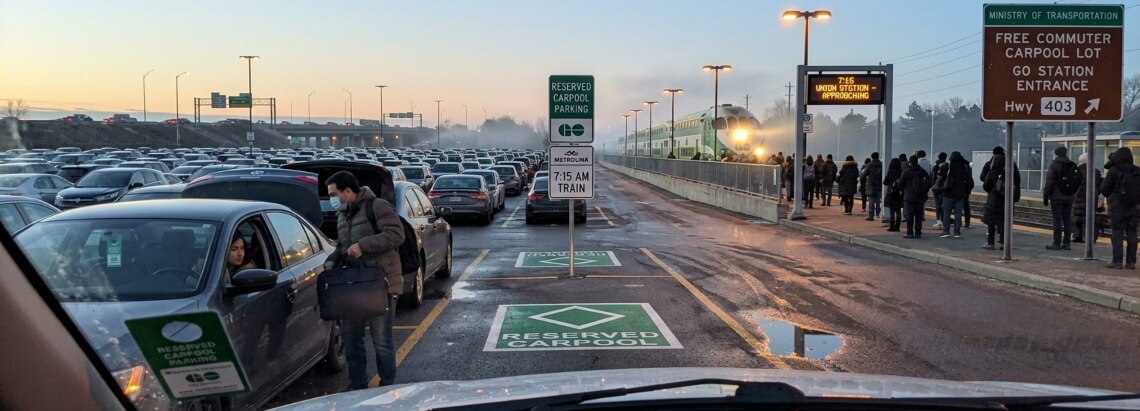
So what is carpool parking? GO Transit stations across the network set aside reserved carpool parking spaces close to the platforms, and the Ministry of Transportation runs free commuter carpool lots at major highway interchanges across Ontario. Both are designed as meeting points: park one car, continue together in the other (or on the train). Check gotransit.com for station-specific parking rules and ontario.ca for the carpool lot map.
Quick Facts
- The average commute time in Toronto hit 34.9 minutes one way in May 2025, the longest of any Canadian metro area (Statistics Canada).
- 89.5% of Canadian car commuters drive alone, so the average car on the 401 at 8 a.m. carries barely more than one person.
- Ontario opened its first highway HOV lanes in December 2005, on Highways 403 and 404.
- Using a dummy or mannequin to fake a passenger in an HOV lane is a real, ticketed offence – the OPP publicizes catches every year.
FAQ
- Does a child count as a passenger for the HOV lane? Yes. Any person of any age counts, including infants in car seats.
- Can I charge my carpool passengers? You can share actual costs (fuel, parking, tolls). Running it for profit turns it into a commercial service with different insurance and licensing requirements.
- Is there a carpool app just for Toronto commuters? No single dominant one. Poparide covers intercity routes, Smart Commute covers member workplaces, and local groups fill the rest.